
Foreign institutional investors have withdrawn nearly $40 billion from Indian equities in the last two years and, according to Bernstein analysts, have 'little reason' to invest for the long-term, though they may 'return to trade'. The brokerage highlights challenges such as struggling large-caps, disruption from new technologies, and difficulties accessing small- and mid-caps (SMIDs) at an institutional scale.

Shiprocket plans to allocate a significant portion of its IPO proceeds towards artificial intelligence (AI), aiming to evolve its e-commerce enablement platform into a comprehensive operating system for merchants, enabling conversational commands and reducing manual tasks.

Infosys co-founder Nandan Nilekani predicts that large corporations in India will lose jobs due to automation and AI, while millions of small businesses will drive future employment growth. He advocates for deregulation, simplified business interfaces, and digital platforms to support small entrepreneurs and a gig economy workforce.

Chief Economic Advisor V Anantha Nageswaran has stressed the urgent need for India's financial sector to proactively address the safety and security risks of artificial intelligence, stating that waiting for problems to materialise is not an option.

Friendship, trust and a little good cop-bad cop magic! This Friendship Day, besties and business partners Hasti Domadia and Hem Choksi reveal how they built a successful business without letting it affect their bond with each other.

Tata Motors' commercial vehicle (CV) business is strategically repositioning itself from a traditional truck manufacturer to a comprehensive logistics and mobility platform, aiming to reduce dependence on cyclical vehicle demand by accelerating growth in digital, international, and services segments.

Indian information technology (IT) stocks, led by Infosys, experienced a significant selloff, dragging the Nifty to a two-month low, primarily due to escalating West Asian tensions pushing crude oil prices higher, and concerns over upcoming large IPOs diverting funds from secondary markets. The sector is also grappling with the long-term implications of AI disruption.

Razorpay CEO Harshil Mathur highlights India's leadership in real-time payments, stating it can foster numerous billion-dollar fintech companies capable of expanding globally. He draws parallels with the US internet boom and discusses how India's unique regulatory and private sector collaboration, exemplified by UPI, can be replicated in other emerging markets. Mathur also touches upon the opportunities and risks associated with leveraging AI in business.

Mahindra Group Chairman Anand Mahindra announced the company would adopt an 'attack mode' strategy, accelerating investment, innovation, and execution to capitalise on opportunities arising from prolonged geopolitical and economic uncertainty.

A global research report by HCLTech indicates that integration has surpassed supply chain constraints as the primary challenge for the semiconductor industry. The study, which surveyed 300 senior leaders, highlights increasing dependency on semiconductors across industries, with 98% of enterprises more reliant now than three years ago and 99% expecting further increases. AI is also driving the strategic importance of semiconductor architecture.

Becoming a shareholder isn't about predicting markets perfectly. What matters more is recognising when you're financially and mentally prepared to participate in wealth creation. If you've been wondering when you should start investing, here are five signs that suggest you're already ready.

Tata Motors has emerged as the biggest market-share gainer among India's leading passenger vehicle (PV) makers in the first eight months of 2026, securing the No. 2 position in the PV market.

A new CLSA report indicates that Eternal's Blinkit is significantly widening its lead in India's quick-commerce sector, particularly beyond major metropolitan areas, by expanding its dark store network and securing a first-mover advantage in over 180 cities.

Tata Motors Passenger Vehicles (TMPV) is strategically expanding its international footprint by launching the Nexon, rebranded as Osprey, in South Africa, a move set to significantly boost its export volumes and solidify India's position as a major automotive export hub.

TeamLease EdTech Founder and CEO Shantanu Rooj states that the AI-driven world transition is irreversible, with regulation and cost being crucial factors determining its speed and depth. He emphasizes that while AI will transform jobs, not eliminate them, continuous learning, domain expertise, and adaptability will be key for individuals and businesses to thrive in this evolving landscape. Rooj also highlights the need for universities to adapt their curricula to prepare a future-ready workforce.
A joint report by Deloitte India and FICCI projects India's consumer economy to reach USD 1.9 trillion by 2030. This growth will be fuelled by rapid AI adoption, evolving consumer preferences, and new commerce models like e-commerce and quick commerce. India leads in AI adoption among top countries, with businesses leveraging it for engagement, innovation, and forecasting. The report also highlights the emergence of a new Indian consumer seeking convenience and transparency, and identifies key trends shaping FMCG, retail, and e-commerce sectors.

RBI Governor Sanjay Malhotra stated that the central bank consistently views fintechs as 'valuable partners' in shaping India's future financial system, crediting the sector with expanding financial inclusion, enhancing customer experience, and streamlining credit delivery, particularly for MSMEs.

'It requires new skilling, new ways of working, and new structures. That's the reality.'

BJP MP Raghav Chadha addressed the 12th IPU Global Conference of Young Parliamentarians in Samarkand, Uzbekistan, highlighting India's digital transformation journey. He emphasised how technology is widening access and promoting inclusion, citing UPI's success, affordable data, and robust data protection laws. Chadha also discussed India's digital cooperation with Uzbekistan and the importance of digital rights, safety, and skill development for all citizens.

Digital money is gradually starting to behave like software. It's no longer inert -- sitting passively in accounts. In the not-so-distant future, your money could become 'smart' and 'active,' understanding your preferences, paying your bills automatically, optimising your returns, and managing your risks -- all without you having to manage the details.
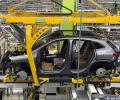
Automobile manufacturers are increasingly vocal about the mounting paperwork and delays associated with India's Production-Linked Incentive (PLI) scheme for the automotive sector, arguing that compliance requirements are becoming as challenging as meeting technical eligibility conditions. They are pushing for a simpler, faster, and more predictable certification and compliance framework.

The Confederation of Indian Industry-Indian Women Network (CII-IWN) organised a hands-on Artificial Intelligence (AI) workshop in Chandigarh for women entrepreneurs and professionals. The session focused on practical applications of AI, including generative AI and LLMs, to address business challenges and enhance productivity across various functions like marketing, content creation, and data analysis.
A report by policy think tank The Dialogue reveals that India's artificial intelligence (AI) ecosystem is primarily constrained by a shortage of skilled talent and a lack of data standardisation, rather than market concentration. The study, which surveyed 308 stakeholders, found that talent availability and data usability are major concerns, with a significant reliance on open-source AI models.

Infosys reported a 12.2 per cent year-on-year increase in consolidated net profit for the June quarter, reaching Rs 7,769 crore, but simultaneously lowered its full-year FY27 revenue growth outlook to 1.5-3 per cent, citing an uncertain macro-environment.

Azim Premji's private investment firm, Premji Invest, has quietly built a formidable portfolio of 11 AI startups, primarily in the US, with a combined valuation of $43 billion. The firm has participated in 19 funding rounds since 2021, with a notable focus on US-based companies, many of which were founded by Indian entrepreneurs.

Tech giant Apple reported a record June quarter revenue of USD 109.4 billion, a 16 per cent year-on-year increase, with significant double-digit growth in emerging markets like India. However, the company anticipates business risks in the coming quarters due to rising memory chip prices and ongoing supply constraints.

'...as we believe with the adoption of AI, our IT services companies' revenue models will have to undergo a reset, which may in turn impact their potential for earnings growth.'

'It seems unlikely that organisations will be a bunch of individuals who work on their own and there are no teams anymore, because that is not sustainable.'

Japanese automaker Honda plans to introduce over 10 new models, including electric vehicles and compact SUVs, in India by 2030, identifying India as one of its three key markets for future growth.
The Indian business model, especially management practices, can serve as a model for the emerging economies, in the next five to ten years, according to Peter Cappelli, management and director, centre for human resources, The Wharton School.

Chandrasekaran's exit is more than a change of chairman. It represents the breakdown of the informal consensus that governed the Tata system under Ratan Tata.

'Healthy double-digit returns are still possible, though a sharp rally is unlikely.'

A rocket designed and developed by ISRO is being transferred to industry for production.
Nine ISRO associations want to know whether this is simply an effort to expand India's industrial capacity or part of a larger policy under which ISRO itself will eventually withdraw from rocket manufacturing.

The biggest challenge to widespread deployment is no longer AI. It is the financial and commerce infrastructure that was built decades ago for deterministic software and human interactions -- not autonomous AI agents.

Skoda Auto is strategically navigating the competitive Indian automotive market by prioritising profitable growth, exploring new powertrain options like CNG and a limited diesel return, and gearing up for a locally produced electric SUV, all while expanding its retail footprint.
High-performance computing server maker Netweb Technologies reported a more than twofold increase in net profit to Rs 85.32 crore for the first quarter ended June 30, 2026. This significant growth was primarily driven by its AI Systems segment, which contributed over 62% of the revenue. The company also saw its revenue from operations more than double to Rs 819.6 crore, reflecting strong demand and disciplined execution, with a robust order book of Rs 2,507 crore.
Videsh Sanchar Nigam Ltd is opting for new business models including Internet Protocol based Virtual Private Network, Microprotocol Label Switching services.

The Indian government has clarified that consumers will not be charged for UPI transactions, and most merchant transactions will also remain free. This comes amidst speculation following an amendment to the Payment and Settlement Systems Act, 2007. Any future merchant discount rate (MDR) would be nominal, threshold-based, and aimed at ensuring UPI's long-term sustainability and infrastructure development.

The aim is to win over the country's enterprises, developers and startups as AI systems shift from answering questions to autonomously executing tasks.

BMW Group India says every Re 1 depreciation in the rupee against the euro trims its profit margin by about 1 per cent, prompting the company to consider further price increases.
